Amillennialism
Recapitulation in Revelation
| Revelation 12:7–11 | Revelation 20:1–6 |
|---|---|
| heavenly scene (v. 7) | heavenly scene (v. 1) |
| angelic battle against Satan and his host (vv. 7–8) | presupposed angelic battle with Satan (v. 2) |
| Satan cast to earth (v. 9) | Satan cast into the abyss (v. 3) |
| the angels’ evil opponent called “the great dragon, . . . that ancient serpent called the devil or Satan, who leads the whole world astray” (v. 9) | the angels’ evil opponent called “the dragon, that ancient serpent, who is the devil, or Satan,” restrained fram “deceiving the nations anymore” (vv. 2–3), to be released later “to deceive the nations in the four corners of the earth” (vv. 3, 7–8) |
| Satan is “filled with fury, because he knows his time is short” (v. 12) | Satan to be “set free for a short time” after his imprisonment (v. 3) |
| Satan’s fall, resulting in the kingdom of Christ and his saints (v. 10) | Satan’s fall, resulting in the kingdom of Christ and his saints (v. 4) |
| the saints’ kingship, based not only on the fall of Satan and Christ’s victory but also on the saints’ faithfulness even to death in holding to “the word of their testimony” (v. 11) | the saints’ kingship, based not only on the fall of Satan but also on their faithfulness even to death because of their “testimony for Jesus and because of the word of God” (v. 4) |
The table above is excerpted from A Case for Amillennialism: Understanding the End Times by Kim Riddlebarger, p. 202. I’ve found a similar table in an essay by Charles Powell arguing against the Amillennial position, Progression Versus Recapitulation in Revelation 20:1-6: Some Overlooked Arguments.
Daniel’s seventy weeks
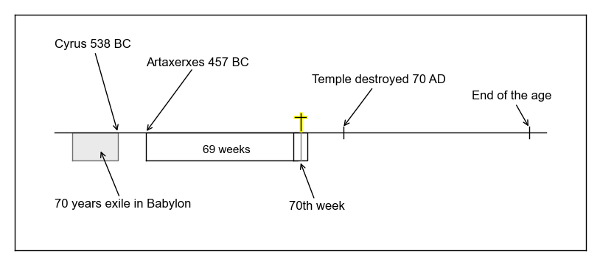
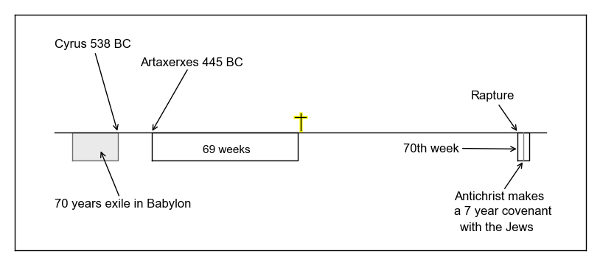
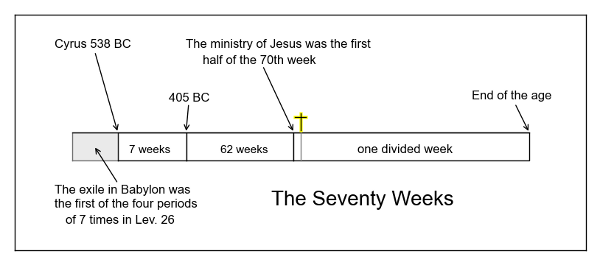
I like these charts I got from Doug Cox’s Creation Concept blog on the various interpretations of the seventy weeks.
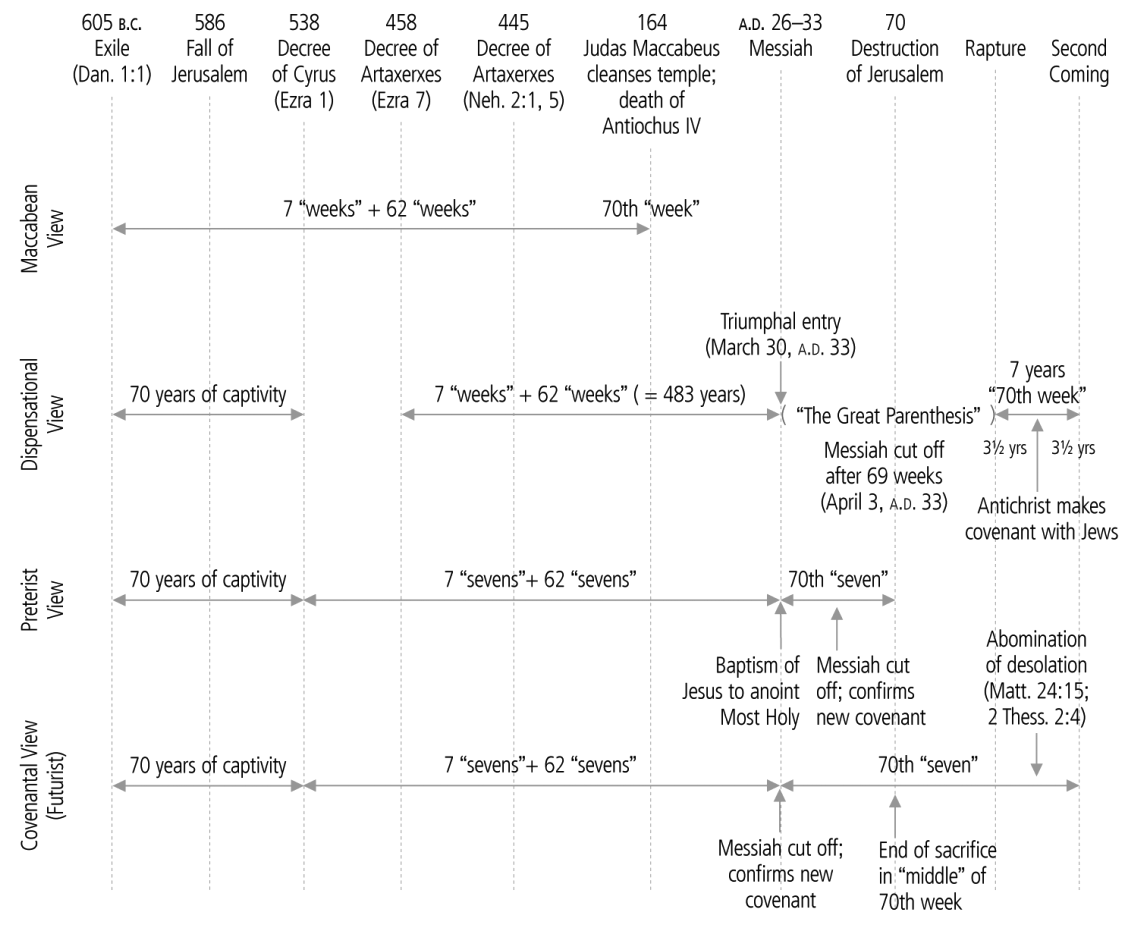
I also like this chart from the ESV Study Bible.
Interesting observation for recapitulation
I was watching a debate between Jacob Hansen and GodLogic about the Trinity, and Hansen made a mistake thinking that the same angel had both said “I am the Alpha and the Omega” and then later commanded John not to worship him since he is a fellow servant. He was conflating two different passages and I assume he went home afterward and figured it out—no big deal, I don’t fault him for a simple mistake—but anyway that was the context that made me curious so I looked up the passage and tried to work it out myself.
There’s actually two places where an angel stops John from worshipping him: Rev 19:10 and Rev 22:9.
In Rev 19:10 it’s not immediately clear who the angel is. It just says in v. 9, “And the angel said to me…”. I think Hansen wants to trace this and just claim the same person has been speaking to John through the whole book of Revelation so this would still be the one at the very beginning who called himself the alpha and the omega. Between Rev 17 and Rev 19 John is careful to distinguish many different voices and other angels he sees carrying out different activities, so when he finally gets back around in Rev 19:9 to “the angel” saying things to him, I think the clearest way to understand it is referring back to the same angel who last addressed him directly in Rev 17:15, and who is introduced in Rev 17:1 as “one of the seven angels who had the seven bowls”.
I thought this was super interesting that we would have a simple referent like “the angel” referring back across two whole chapters, and I immediately wondered if that spanned across two different recapitulation sections in Revelation. If it did, I don’t know if that would cast doubt on the recapitulation theory, but I wondered anyway. Turns out, no!, one of the recapitulated sections is Rev 17–19, so this checks out.
So what about the angel in Rev 22:9? Is that the same angel and does that reference span across the two recapitulated sections Rev 17–19 and Rev 20–22?
Turns out, it is the same angel, but (and maybe I’m up in the night but this strikes me as really strong evidence for recapitulation!) the angel gets reintroduced in Rev 21:9: “Then came one of the seven angels who had the seven bowls full of the seven last plagues and spoke to me…”. Why would the angel need to be reintroduced?? This strikes me as a clear indication that the narrative reset.
There is a narrative break somewhere between the end of chapter 19 and the middle of chapter 21, otherwise the author would have no qualms about just calling him “the angel” again and trusting us to understand what that refers back to. But he’s started over with another section and so feels the need to explicitly re-introduce the angel as if this is the first time in the narrative we’re hearing him speak.
For further study: Can I find other indicators like this that would hold for all the different narrative breaks (each successive recapitulation) in Revelation?
WHOA, PLOT TWIST: Jacob Hansen was right. The angel who commands John not to worship him in Rev 22:9 actually goes on to say “I am the Alpha and the Omega, the first and the last, the beginning and the end,” and later the angel says, “I, Jesus, have sent my angel to testify to you about these things for the churches.” So the angel is speaking to John the very words of God [Jesus], which Hansen takes as a reason for why John would make the mistake of wanting to worship the angel. John heard the angel speaking the very words of God and assumed the angel was a manifestation of God, so the angel had to correct him. And this is perhaps the clearest example I’ve seen of the Latter-day Saint doctrine of divine investiture.